
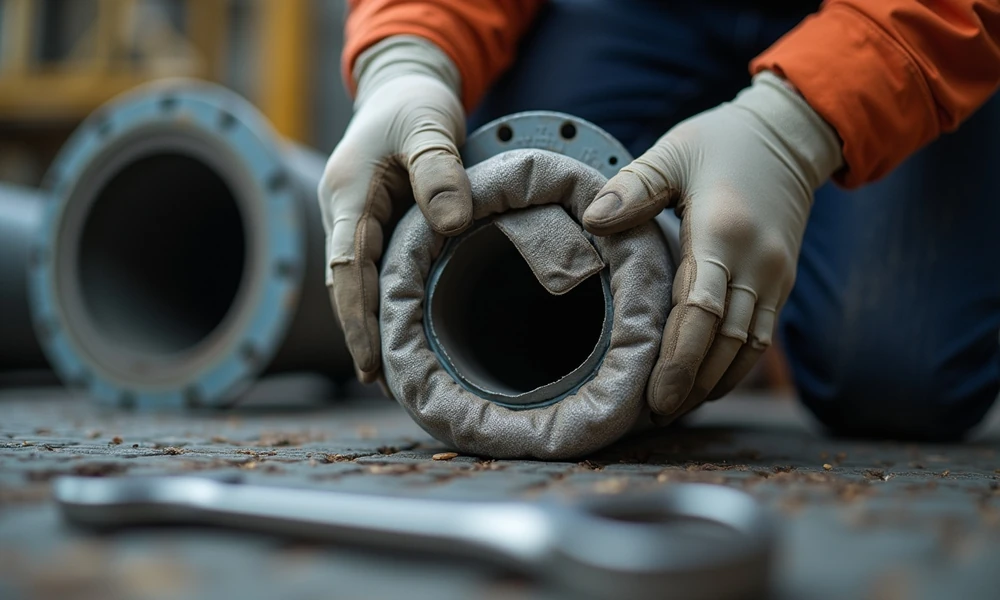
Insulating a flange joint seems like a straightforward thermal efficiency decision, but the method chosen has consequences that extend well beyond heat retention. Permanent lagging, once installed, becomes a barrier to routine bolt inspection and leak detection, both of which are essential at flange connections specifically because these joints are more prone to loosening or seal degradation than straight pipe runs. Maintenance teams comparing an insulation blanket for flanges against traditional lagging are increasingly finding that accessibility, not just thermal performance, should drive the decision.
1. Inspection Access Without Full Removal of Insulation
Flange joints require periodic bolt torque checks and visual inspection for leaks, both of which become considerably more labour-intensive when permanent lagging has to be chipped away or cut to reach the joint underneath. Removable insulation blankets are designed with closures, typically Velcro straps or lacing, that allow a technician to open and reseal the cover in minutes rather than hours. This accessibility matters most in facilities where flange inspection is a recurring, scheduled task rather than a rare event, since the cumulative time saved across dozens of inspection cycles becomes substantial.
2. Reduced Downtime During Turnarounds
Plant turnarounds operate on tight schedules, and any task that takes longer than necessary has a knock-on effect across the entire maintenance plan. Permanent lagging removal during a turnaround often requires additional labour and disposal of damaged insulation material that cannot be reused once cut away. An insulation blanket for flanges can be unfastened, set aside, and refitted after inspection or repair work is complete, which noticeably shortens the time a joint remains exposed and reduces the volume of insulation material that needs replacing after each turnaround cycle.
3. Consistent Thermal Performance Without Sacrificing Flexibility
There’s a common assumption that removable insulation sacrifices thermal efficiency for convenience, but well-manufactured removable insulation blankets are built with the same high-performance insulating cores used in permanent systems, simply housed within a durable, refittable outer jacket. This means facilities don’t need to choose between thermal efficiency and accessibility, since a properly specified blanket can match the insulating value of lagging while remaining fully removable for maintenance purposes.
4. Lower Long-Term Material and Labour Costs
While the upfront cost of a removable insulation blanket for flanges can be higher than basic lagging material, the long-term cost picture often favours the removable option once repeated inspection and re-insulation cycles are factored in. Permanent lagging typically needs to be replaced entirely each time it’s removed for inspection, while a well-maintained blanket can be reused across many inspection cycles with only occasional replacement of worn closures or outer covers. Over the lifespan of a facility’s maintenance programme, this reuse factor can meaningfully reduce both material spend and the labour hours needed for repeated fabrication.
5. Improved Safety Around Personnel Protection
Flange joints handling high-temperature process fluids present a genuine burn risk to personnel working nearby, and insulation serves a personnel protection function as much as an energy efficiency one. Removable insulation blankets maintain this protective barrier continuously, since they’re designed to stay in place during normal operation and are only removed briefly for scheduled inspection, rather than being left exposed for extended periods while replacement lagging is fabricated and reinstalled.
Comparing the Two Approaches
| Feature | Permanent Lagging | Removable Insulation Blankets |
| Inspection access | Requires cutting or chipping away | Opens and reseals in minutes |
| Turnaround impact | Longer downtime, material disposal | Faster refit, less waste |
| Thermal performance | High, but inflexible | Comparable, with added flexibility |
| Long-term cost | Repeated full replacement | Reusable across multiple cycles |
| Personnel protection | Consistent while intact | Consistent, with brief planned gaps |
Making the Switch Where It Matters Most
Not every insulated joint in a facility necessarily needs to switch to a removable system, particularly for connections that are rarely accessed once commissioned. But for flanges subject to regular inspection schedules, valve maintenance, or frequent process changes, the accessibility advantage of a removable system tends to outweigh the marginally higher upfront cost. Identifying which joints in a facility fall into this category is usually the clearest starting point for planning a targeted upgrade rather than a full facility-wide replacement.
Contact Ancloz Engineering to assess which flange joints in your facility would benefit most from switching to removable insulation blankets.